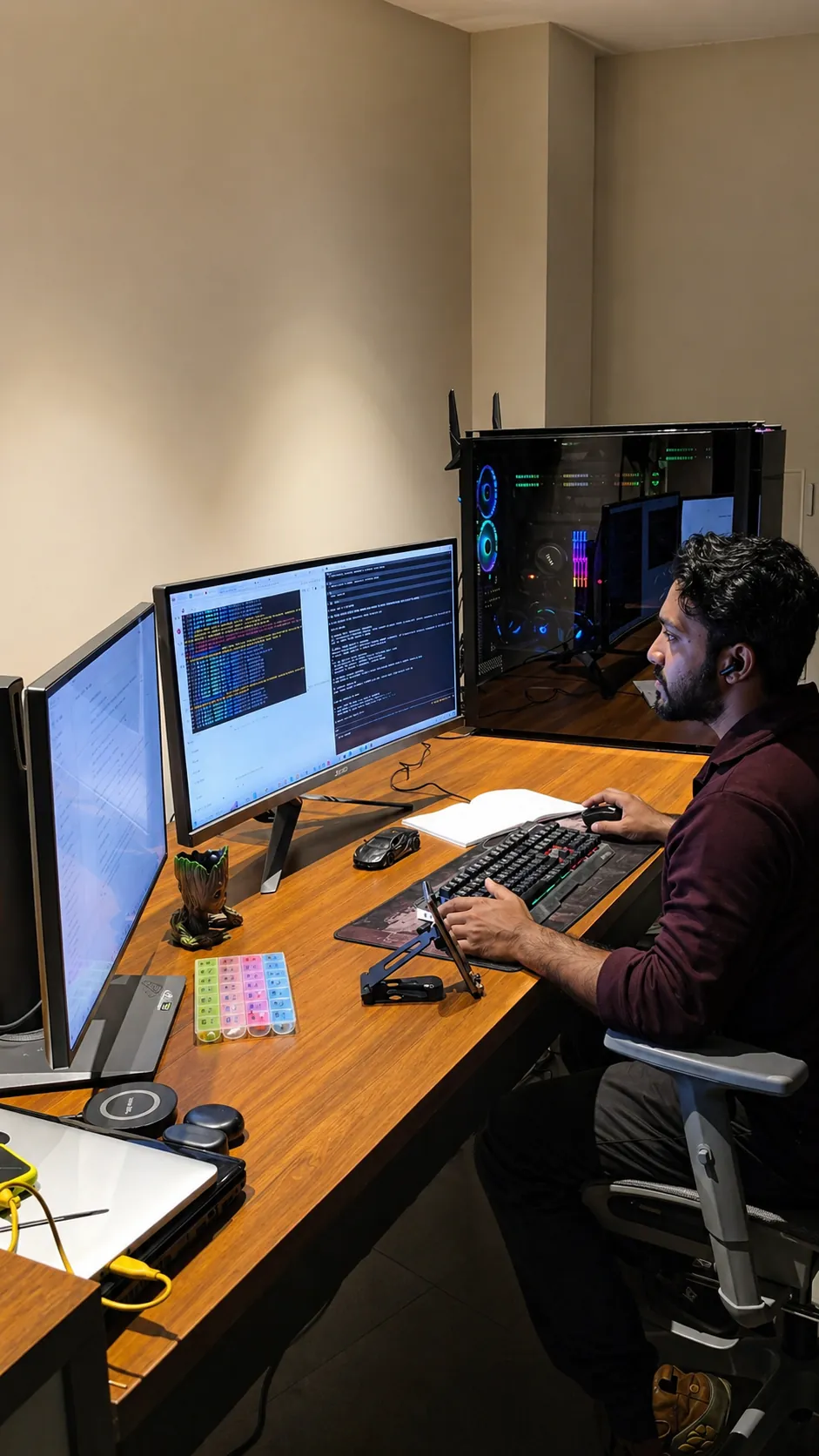
I’m a CS engineer who got too curious about the business side of software — and then never came back. I trained as an engineer at the Mangalore Institute of Technology and Engineering, but the thing that actually pulled me in wasn’t the code. It was the question of why so many real businesses were running on duct tape and willpower.
I started building small e‑commerce projects to answer that question for myself. Most of them failed. A few worked. The ones that worked taught me something the textbooks never did: operations is the actual product. The store on the front end is just the receipt.
The portfolio
Today I run a private portfolio of digital properties. Some are e‑commerce stores, some are content properties, some are experimental. I won’t name them on this site — partly because I prefer to let the work speak for itself, and partly because most of what’s interesting about them isn’t the brand on the front. It’s the system underneath.
A typical week looks like a queue of small operational decisions: which workflow to automate, which manual step is about to break at scale, which margin to protect, which customer signal to actually act on. The job is mostly making sure the stores can run a week without me — and then a month, and then a year.
The stores aren’t the achievement. The fact that they keep running while I sleep is.
The shift to systems
A few years in, I noticed I was solving the same five problems across every store. Order syncing. Inventory. Customer service. Retention. Reporting. The names changed, the niches changed, but the shape of the work was identical.
That’s the moment systems thinking stops being a buzzword and becomes the only honest way to work. If you’re a solo operator with five stores, you can’t do five times the work. You either build software that runs the work, or you go under.
So I went deep on automation — n8n, Make, the Claude and OpenAI APIs, Supabase, custom scripts. Not because I think AI is magic. Because the cost of replacing a manual task has gone down enough that almost every recurring task is now worth automating, and most operators haven’t caught up to that fact yet.
Why this site exists
For a long time I built quietly. Most of my peers were posting screenshots of revenue dashboards on LinkedIn. I wasn’t. I still won’t. But the longer I went without writing anything, the more I noticed the operators around me were drowning in the same problems I’d already solved — and re‑solved — over the last few years.
This site is the field manual I wish I’d had. It’s the writing, the stack, the systems, and the small set of products I’m packaging from work I’ve already done. Nothing on this site is theoretical. Everything came from a store that had a problem on a Tuesday at 11pm.
What I care about
- Operators over influencers. People who run things over people who talk about things.
- Boring competence over hype. The compounding kind, not the launch‑week kind.
- Systems over personalities. If it falls apart when I’m asleep, it’s not built right.
- Honest writing. If I haven’t done it, I won’t write about it.
If you’re here for commercial work
My commercial work — automation systems, operational workflows, productized engagements for D2C teams — lives at digitalshijil.com. This site is the trust layer. That site is where you go if you want to actually start something together.
If you’re here just to read, or to follow the build, or to learn — that’s also fine. The writing is free, the stack is open, and the goal is the same either way: make a few more operators a little bit harder to break.